

Table of Contents
- How to Set Up Altar Space: Location and Foundation
- What to Put on an Altar: Objects and Symbols
- Pagan Altar Setup: Tradition-Specific Guidance
- Four Elements Altar: Working with Directions
- How to Dedicate an Altar for Your Practice
- Small-Space and Discreet Altar Setups
- Safety and Caring for Your Altar Materials
- Maintaining and Refreshing Your Altar Over Time
- Frequently Asked Questions
Last Updated: October 8, 2026
How to Set Up Altar Space: Location and Foundation
Learning how to set up altar space starts with one honest question: where will you actually use it? A home altar is a physical place for spiritual practice, and it works best when it fits your daily life instead of fighting it.
You do not need a spare room. You need a surface, a few meaningful objects, and a reason to return to it.
A common mistake is copying someone else's elaborate setup. Start small and let the space grow with your practice.
Merriam-Webster definition of altar
Choosing Your Altar Location
Pick a spot you pass every day. A bedroom corner, a windowsill, or the top of a low bookshelf all work.
What matters is that the location feels calm and gets some natural light. Avoid high-traffic zones like a kitchen counter where mail piles up.
- East-facing spots suit morning practice
- Quiet corners help with meditation and intention setting
- Somewhere private keeps your ritual space undisturbed
If you share your home, choose a location others will not bump into or move.
Selecting Your Altar Surface
Any flat, stable surface can serve as an altar table. A small shelf, a wooden tray, or a nightstand all work.
Height matters more than material. Standing altars suit active ritual work; low surfaces suit seated practice.
What to Put on an Altar: Objects and Symbols
An altar holds objects that carry meaning for you. There is no required shopping list, and no single tradition owns the correct arrangement. What separates a working altar from a decorative shelf is that every item has a job and a reason.
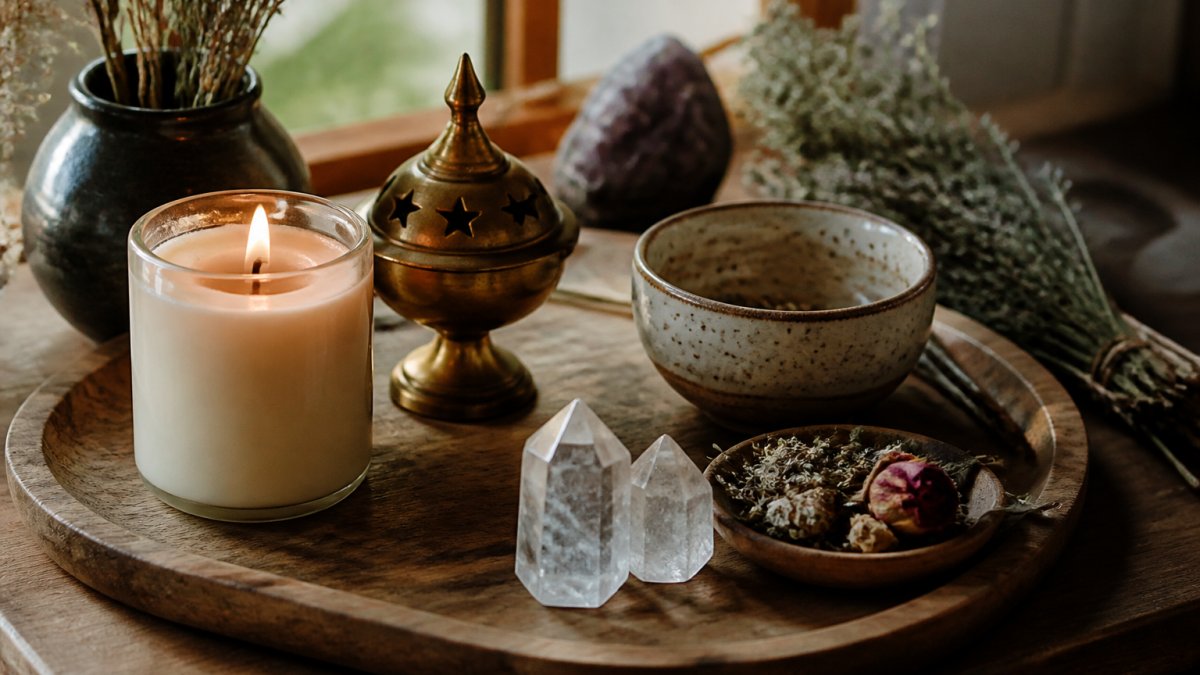
A Minimal Starter List
If you are unsure what to buy first, start here and add nothing else for two weeks. Most practitioners find that a small, used altar teaches more than a crowded one.
- One candle and a snug holder, the marker that opens and closes practice
- One small bowl, the receiver for water, salt, herbs, or grain
- One personal token, a photo, stone, ring, or note
- One scent source, optional, incense, a diffuser, or a simmer pot
- One cloth or tray, defines the edge of the space and catches drips
That is five items, and three of them are likely already in your home. You do not need a dedicated table to begin; a nightstand, a windowsill, or the top of a low bookshelf works.
Candles, Incense, and Offerings
Candles mark the start of ritual. Choose holders that fit snugly, sit on a heat-safe base, and are wider than the candle so wax cannot run onto the surface. A candle snuffer ends a flame without blowing wax or scattering ash.
Incense or an incense burner adds scent and signals a shift in focus. An offering bowl holds small gifts: water, salt, herbs, or a pinch of grain. Empty and refresh the bowl regularly, a bowl that stays full of old water stops reading as an offering and starts reading as clutter.
- Candle holders: steady, non-flammable, wider than the candle
- Candle snuffer: ends a flame without blowing wax
- Incense burner: heat-safe with a catch tray for ash
- Offering bowl: any small dish you reserve for this purpose
Personal Symbols and Meaningful Decor
This is where your altar becomes yours. Family photos, stones from a trip, or a piece of jewelry can all belong here. Moon phases, astrological symbols, and tarot cards are common decor choices, as are carving tools and a pestle and mortar if you blend your own herbs.
Budget and Sourcing Notes
You can build a complete starter altar for very little. Thrift stores, estate sales, and dollar stores routinely carry candle holders, small dishes, and trays. A mason jar with a tea light, a cereal bowl, and a printed photo is a legitimate altar.
If you buy from a maker, ask what the item is made of. Soy and beeswax candles burn cooler and with less soot than paraffin. Unglazed ceramic and cast iron hold up to wax and ash better than thin glass.
Pagan Altar Setup: Tradition-Specific Guidance
Most altar guides online present one layout as if it fits everyone. It does not. What belongs on an altar depends heavily on the tradition you follow, and treating all of it as interchangeable is both inaccurate and, in some cases, disrespectful. This section is the part most guides skip: what is broadly applicable, what is tradition-specific, and how to borrow without overstepping.
What Is Broadly Applicable
A few things hold true across nearly every path that uses an altar:
- A stable, clean surface you return to regularly
- A way to mark the beginning and end of practice (a flame, a bell, a breath)
- A place to put offerings or tokens
- Objects that carry personal meaning
If you are not sure which tradition fits you, build on these four and stop there. You are not doing it wrong.
Ancestors, Altars and Spirits Class →
What Is Tradition-Specific
These are examples of how different paths diverge. They are descriptions, not instructions, if a path is not yours, do not adopt its tools as decoration.
- Wiccan altars often honor a god and goddess with paired candles, and may include a chalice, athame, pentacle, and wand arranged in relation to the four quarters. The specific placement is taught within a coven or tradition, not standardized across all Wicca.
- Heathen and ancestral practices may center offerings to ancestors or to specific deities, with a horn or bowl for liquid offerings and a space for a remembered name or photo. Blót and sumbel are structured rituals with their own etiquette.
- Hellenic, Roman, and other reconstructionist paths often include a hearth flame, a libation bowl, and offerings appropriate to the specific deity or household spirit being honored.
- Folk and family traditions vary enormously and are often passed down orally. If you have one in your family, ask before you assume.
Borrowing Respectfully
If you are exploring rather than following a specific path, a few habits keep you on solid ground:
- Read before you adopt. Learn what a tool is for in its own tradition before you place it on your altar.
- Ask practitioners, not search results. Community forums and local groups will tell you what is appropriate to borrow and what is not.
- Skip closed practices. Some traditions are not open to outsiders, and that boundary is not a challenge to work around.
- Say what you are doing. "I am exploring" is a complete and honest answer. Pretending to belong to a tradition you do not is the fastest way to look foolish and cause offense.
- Do not mix and match carelessly. Combining tools from unrelated traditions without understanding either one produces an altar that means nothing to anyone, including you.
For ancestor-focused work, our Ancestors, Altars and Spirits Class walks through veneration and altar setup step by step.

Four Elements Altar: Working with Directions
A four elements altar maps earth, air, fire, and water to the four directions. Many practitioners place earth in the north, air in the east, fire in the south, and water in the west.
You do not need four separate objects. One item per element is enough.
| Direction | Element | Common Object |
|---|---|---|
| North | Earth | Salt, stone, bowl of soil |
| East | Air | Incense, feather, bell |
| South | Fire | Candle, charcoal, sun symbol |
| West | Water | Shell, cup of water, sea glass |
Arrange the items in a circle or a cross, then stand at the center. This simple layout gives beginners a clear structure to build on.
How to Dedicate an Altar for Your Practice
Dedicating an altar means naming its purpose. It is a short ritual, not a ceremony you need training for.
- Clean the surface and clear the space
- Light a candle and take a few slow breaths
- State out loud what this altar is for
- Name each object and why it belongs
- Close with thanks and let the candle burn safely
Write your intention down and keep it nearby. Revisit it whenever the altar starts feeling like furniture.
Small-Space and Discreet Altar Setups
Small-space altars work on the same principles as large ones, just compressed. A tray, a tin, or a shoebox can hold a complete practice.
Discreet setups matter for renters, shared homes, and anyone who wants privacy.
- Use a lidded box you can close and store
- Build a travel altar in an altoids-style tin
- Choose a shelf that reads as decor to visitors
A ritual tray keeps everything contained. Our Hexproof Spellcaster's Ritual Tray is built for exactly this: altar styling, candle practice, and incense, all in one moveable surface.

Safety and Caring for Your Altar Materials
Safety comes before aesthetics on any altar. Fire, ash, and oils all need a little respect.
- Place candles on heat-safe, non-flammable bases
- Keep flames away from curtains, paper, and dried herbs
- Never leave a burning candle or incense unattended
- Trim wicks to about a quarter inch before each use
- Keep ritual goods away from children and pets
For accessibility, swap open flame for LED candles or a diffuser. The intention carries; the smoke does not have to.
Maintaining and Refreshing Your Altar Over Time
An altar is a living space, so it collects dust, wax, and stale energy. A short refresh every month keeps it useful.
- Wipe the surface and clear old wax
- Empty and wash the offering bowl
- Replace dried flowers and spent herbs
- Remove objects that no longer fit your practice
- Re-state your intention for the season ahead
Many practitioners refresh at the new moon. Others do it whenever the space stops drawing them in. Both work.
Our Invoke My Ancestors Spell Candle is made from 100% soy wax for ancestor veneration and altar work, so it fits a recurring practice without harsh residue.

Setting up an altar can feel intimidating when every guide shows a different, elaborate result. Browse the Shop All collection and build a setup that fits your practice, your room, and your values.
Frequently Asked Questions
How do you activate or dedicate an altar?
Dedication is a formal act of setting your altar apart for spiritual work. Many practitioners cleanse the space first with incense or sound, then state aloud their intention for the altar. You might light a candle and speak what the space is for, such as healing, protection, or ancestor connection. Some traditions call on the four elements or specific deities. A dedicated altar becomes a focused point for ritual and intention-setting, distinct from ordinary furniture.
What should a beginner put on an altar?
Start with a few meaningful items rather than filling every inch. A candle for light and focus, a small bowl for offerings, and one personal symbol like a crystal, photo, or stone are enough. If you plan a four elements altar, add a cup for water and a dish of salt for earth. You can grow your collection over time as your practice deepens. The objects matter less than the intention behind them.
How often should you refresh or maintain an altar?
Refresh your altar when it feels stagnant, after completing a major intention, or at seasonal shifts like the new moon or solstices. Simple maintenance includes dusting surfaces, replacing spent candles, and emptying ash from incense burners. Some practitioners change offerings weekly or monthly. There is no fixed rule, but regular care keeps the space active and respectful. Let your spiritual practice guide the timing.
Where should you place a home altar?
Choose a spot where you can focus without frequent interruption. A corner of a bedroom, a shelf in a quiet room, or a small table in a living area all work. Avoid high-traffic zones and places near televisions or clutter. If you share your home, a discreet setup on a bookshelf or inside a cabinet keeps your practice private. East-facing placements are traditional in some paths, but any intentional location is valid.